
Engagement Options
1. Operational Performance Diagnostic
- Duration: 2 to 4 weeks (scope-dependent).
- Best for: Organisations experiencing performance constraints, recurring firefighting, visible margin erosion, or poor delivery reliability — where the root cause is not yet clearly understood.
- Outputs are operation-specific and vary by scope, but typically include:
- Current-state performance map - where time, quality, capacity, and cost are being lost.
- Root-cause theme summary - preventing symptom-chasing.
- Prioritised quick-win register.
- Transformation opportunity map - quantified improvement potential.
- Executive decision roadmap - a structured basis for deciding what to do next.
2. Lean: Flow, Speed, and Waste Elimination
- Duration: 4 to 12 weeks (scope-dependent).
- Best for: Long lead times, queueing, rework loops, poor handoffs, stop-start production, and poor delivery predictability.
- Outputs are operation-specific and vary by scope, but typically include:
- Redesigned process flow with waste and non-value steps removed.
- Standard work documentation and visual management tools.
- Capacity and bottleneck analysis model.
- Daily management cadence for sustaining the improved flow.
3. Six Sigma: Quality, Variation, and Process Capability
- Duration: 8 to 16 weeks (scope-dependent).
- Framework: DMAIC (Define, Measure, Analyse, Improve, Control).
- Best for: Recurring defects, unstable output quality, hidden variation, weak measurement confidence, and high inspection or rework cost.
- Outputs are operation-specific and vary by scope, but typically include:
- Validated root cause - statistically confirmed, not assumed.
- Improved process capability (Cpk/Ppk and Sigma Level targets).
- A control plan and monitoring system that prevents reversion.
- Measurement System Analysis (MSA), where measurement confidence is at issue.
4. Lean Governance: Making Results Permanent
- Duration: 4 to 10 weeks (can run concurrently with improvement work).
- Best for: Improvement initiatives that have faded, inconsistent adherence to new standards, weak escalation disciplines, or organisations that want to lock in gains before the engagement closes.
Outputs are operation specific and vary by scope, but typically include:
- Governance cadence and operating system rhythms (daily, weekly, monthly).
- Visibility and accountability structures - visual management, escalation protocols.
- Leader standard work: clear expectations for managers at each level.
- Sustainability design: a practical plan for maintaining performance without external support.
Which engagement option is right for your situation?
| Your situation | Where to start |
| I know something is wrong, but I cannot isolate the cause | Start with the Diagnostic |
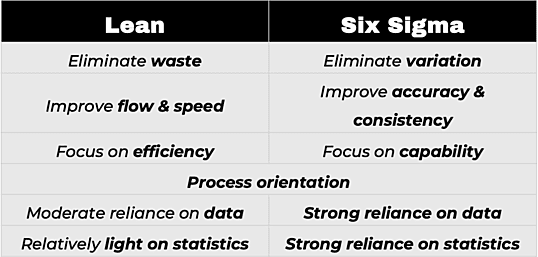
| Lead time, slow throughput, and poor delivery are the main problems (efficiency, velocity, and flow). | Lean engagement |
| Defects, rework, and inconsistent quality are the main problems (accuracy, variation, and capability). | Six Sigma engagement |
| We improved things once, but the gains have not held. | Lean Governance |
| I need both speed and quality fixed. | Diagnostic first, then Lean to stabilise, followed by targeted Six Sigma |
| I am not ready to commit budget yet. | Contact us for a no-obligation scoping conversation |
Our commitment for every engagement
- We start with the operation as it actually is, no presuppositions, not as the documentation says it should be. Evidence before opinion, always.
- We will tell you honestly and respectfully what we find, even when the finding is uncomfortable. Clarity serves you better than diplomacy.
- We work alongside your team, not above them. Solutions that your people cannot understand and maintain are not solutions.
- We focus on implementation, not just diagnosis. A finding without a change is an expensive observation.
- We design for sustainment from the outset. Governance, standards, and ownership are built into the work, not added at the end.
- We transfer capability as we go. When we leave, your team should be more capable than when we arrived.
- We do not create dependency. Ongoing engagement is always your choice, never a structural requirement.
What some of our engagements have
delivered for clients
18% improvement in annualised NPBITD within 9 months (A plastic packaging manufacturer)
Customer satisfaction improved to above 90% on delivery reliability (Production client)
Rework, scrap, and inspection lead times substantially reduced (Aeronautics defence manufacturer)
Successful industrialisation of military vehicle production from prototype to volume output (Military contractor)
32% release of working capital tied up in inventory (Cement group SAP implementation)
Lean and Six Sigma Frameworks
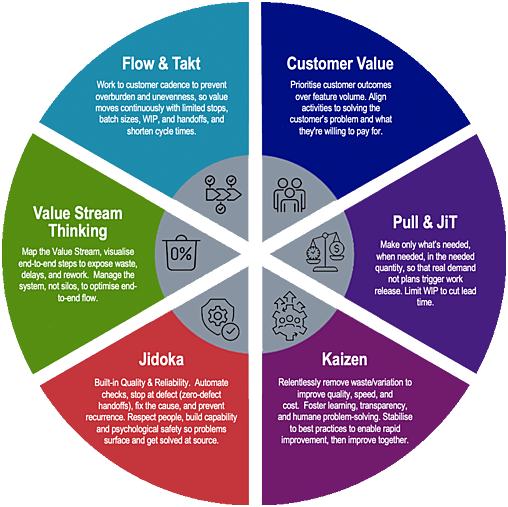
The Six Principles of LEAN
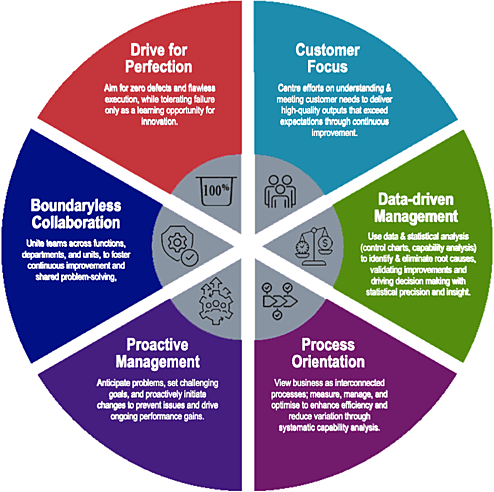
The Six Principles of SIX SIGMA
Capability Transfer: Education and Training
- Capability transfer is built into every engagement, but for organisations that want more structured Lean or Six Sigma education delivered to their teams, we offer targeted training as a standalone engagement.
- Lean Education: Delivered across selected Lean tools and methods tailored to your team's role and the specific improvement context.
- Six Sigma Education: Executive briefings, stakeholder clinics, and project-team workshops that build the knowledge needed to engage effectively with Six Sigma projects, without requiring every participant to become a statistician.